Aquifer Family Medicine Continues to Lose Connection


In collaboration with:
Society of Teachers of Family Medicine (STFM)

The 40 interactive virtual patient cases in AquiferSM Family Medicine deliver on the learning objectives of the Society of Teachers of Family Medicine's (STFM) clerkship curriculum, powered by AqueductSM, Aquifer's teaching and learning platform.
Overview
Aquifer Family Medicine (formerly fmCASES) builds clinical competency, fills educational gaps, and helps instill the core values and attitudes of family medicine. The course fosters self-directed and independent study, develops clinical problem-solving skills, and teaches an evidence-based, patient-centered approach to patient care.
Key Features
- Created for educators, by educators, to cover the full range of STFM curriculum
- Available for institutional subscription or for direct purchase by individual subscribers
- Validated 100-question online summative exam available at no additional cost through the 2022-23 subscription year
- Proven pedagogy that standardizes experiences—overcoming geography, seasonality, and accessibility
- Evidence-based, peer-reviewed, and continuously updated content
- Self-assessment questions emphasize key content and enable students to test their knowledge and skills
- A wealth of source material, tools, and full references in each case
- Delivered via the Aqueduct teaching and learning platform, which includes user management options, easy reporting on student progress and course usage, plus tools for creating custom courses to match a specific curriculum
- Access toAquifer Calibrate: Transformative Assessments for Clinical Learning Mastery, our innovative system for formative assessment, available to Aquifer 2022-23 Curricular Partners
Course Content
This course covers the complete STFM Family Medicine Clerkship Curriculum. Course content includes five Aquifer Pediatrics cases and two Aquifer Internal Medicine cases to help cover the full range of family medicine learning objectives.
Self Assessment Questions, included with the course content, are a valuable component of the learning and have been shown to improve student performance on exams (Seagrave et al, 2016).
Curriculum Integration
Aquifer Family Medicine can be used by third-year medical students, Physician Assistant students, and Nurse Practitioner students as a complement to a clerkship or course on family medicine.
Research has shown that students who complete more cases perform better on the Aquifer Family Medicine exam (Chessman et al, 2013). Even if you aren't requiring all 40 cases, we recommend encouraging your students to complete as many cases as possible.
Exam
Aquifer Calibrate, aninnovative system for formative assessments, is in development for Aquifer Family Medicine. The new assessments will combine the concepts of test-enhanced learning and distributed practice tofacilitate efficient study planning and self-directed learning for students, and identify at-risk students and curricular gaps for faculty.
Our current 100-question summative multiple-choice exam will continue to be available through June 2023.
Aquifer's online, validated summative exam is included with your Aquifer Family Medicine course subscription. Unlike the NMBE, our 100-item, multiple-choice exam was created by Society of Teachers of Family Medicine (STFM) educators as an assessment tool based specifically on the Family Medicine clerkship curriculum.
The exam is delivered in a secure browser and accompanied by student assessment reports with individual and class data. It can be used to replace or enhance an existing comprehensive assessment or to remediate students. The exam has also been found to improve NBME performance when used as a pre-test (Nguyen 2018).
A study of 130 medical students at one institution found the percent correct on the Aquifer Family Medicine and NBME examinations were highly correlated (Pearson correlation coefficient = 0.607). Using linear regression, performance on the Aquifer Family Medicine exam was a very strong positive predictor of subsequent NBME scores (p=.00000000000002) (Sussman, 2012).
Case List
Family Medicine 01: 45-year-old female wellness visit
Family Medicine 02: 55-year-old male wellness visit
Family Medicine 03: 65-year-old female with insomnia
Family Medicine 04: 19-year-old female with sports injury
Family Medicine 05: 30-year-old female with palpitations
Family Medicine 06: 57-year-old female diabetes care visit
Family Medicine 07: 53-year-old male with leg swelling
Family Medicine 08: 54-year-old male with elevated blood pressure
Family Medicine 09: 50-year-old female with palpitations
Family Medicine 10: 45-year-old male with low back pain
Family Medicine 11: 74-year-old female with knee pain
Family Medicine 12: 16-year-old female with vaginal bleeding and UCG
Family Medicine 13: 40-year-old male with a persistent cough
Family Medicine 14: 35-year-old female with missed period
Family Medicine 15: 42-year-old male with right upper quadrant pain
Family Medicine 16: 68-year-old male with skin lesion
Family Medicine 17: 55-year-old post-menopausal female with vaginal bleeding
Family Medicine 18: 24-year-old female with headaches
Family Medicine 19: 39-year-old male with epigastric pain
Family Medicine 20: 28-year-old female with abdominal pain
Family Medicine 21: 12-year-old female with fever
Family Medicine 22: 70-year-old male with new-onset unilateral weakness
Family Medicine 23: 5-year-old female with sore throat
Family Medicine 24: 4-week-old female with fussiness
Family Medicine 25: 38-year-old male with shoulder pain
Family Medicine 26: 55-year-old male with fatigue
Family Medicine 27: 17-year-old male with groin pain
Family Medicine 28: 58-year-old male with shortness of breath
Family Medicine 29: 72-year-old male with dementia
Family Medicine 30: 27-year-old female labor and delivery
Family Medicine 31: 66-year-old female with shortness of breath
Family Medicine 32: 33-year-old female with painful periods
Family Medicine 33: 28-year-old female with dizziness
Pediatrics 01: Newborn male infant evaluation and care
Pediatrics 02: Infant female well-child visits (2, 6, and 9 months)
Pediatrics 03: 3-year-old male well-child visit
Pediatrics 04: 8-year-old male well-child check
Pediatrics 13: 6-year-old female with chronic cough
Internal Medicine 02: 60-year-old female with episodic chest discomfort
Internal Medicine 16: 45-year-old male with obesity
From Our Cases
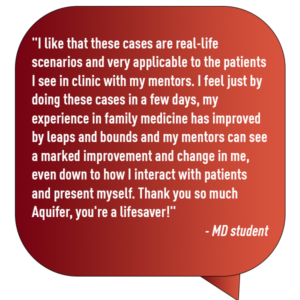
User Story
Learn how Aquifer Family Medicine can benefit medical students and faculty in your program:
Academic Presentation
Aligning the National Clerkship Curriculum, the NBME, and Aquifer Family Medicine's Learning Objectives for Enhanced Curricular Mapping
From the Society of Teachers of Family Medicine Medical Student Education Conference 2021:
Aquifer Family Medicine Course Board
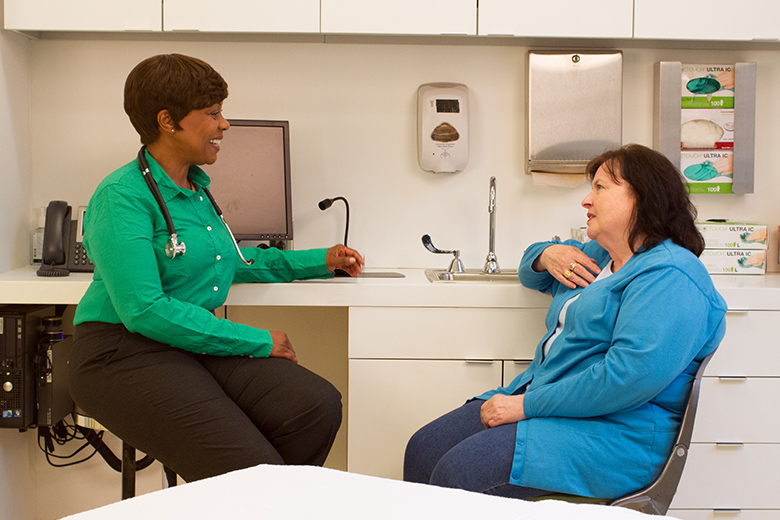

In collaboration with:
Alliance for Academic Internal Medicine

The 36 interactive virtual patient cases in Aquifer Internal Medicine deliver on the learning objectives of Clerkship Directors in Internal Medicine's (CDIM) General Internal Medicine Core Medicine clerkship curriculum.
Overview
Aquifer Internal Medicine builds clinical competency and fills educational gaps in internal medicine curricula. The course fosters self-directed and independent study, develops clinical problem-solving skills, and teaches an evidence-based, patient-centered approach to health care.

Important Update to Internal Medicine Case 3
Aquifer Internal Medicine 03 – 54-year-old female with Syncope, has been updated, and is now called Aquifer Internal Medicine 03 – Four Patients with Syncope. It is available for all Aquifer Internal Medicine subscribers as of July 1, 2022.
The updated version of this case now follows four different patients instead of one, each of whom has the same concern, but with differing etiologies. By covering four patients with the same concern, the updated case allows students to sharpen their clinical reasoning skills. Learn more…
Key Features
- Created for educators, by educators, to cover the full range of CDIM's curriculum
- Available for institutional subscription or for direct purchase by individual subscribers
- Innovative Clinical Decision-Making Exam in the key features format available at no additional cost
- Proven pedagogy that standardizes experiences—overcoming geography, seasonality, and accessibility
- Evidence-based, peer-reviewed, and continuously updated content
- Self-assessment questions emphasize key content and enable students to test their knowledge and skills
- A wealth of source material, tools, and full references in each case
- Delivered via the Aqueduct teaching and learning platform, which includes user management options, easy reporting on student progress and course usage, plus tools for creating custom courses to match a specific curriculum
- Access toAquifer Calibrate: Transformative Assessments for Clinical Learning Mastery, our innovative system for formative assessment, available to Aquifer 2022-23 Curricular Partners
Course Content
Realistic case scenarios that demonstrate best-practices create an invaluable bridge from content to practice for our students. Aquifer Internal Medicine cases help students to develop the clinical reasoning skills critical to becoming a successful practitioner.
Curriculum Integration
Although designed for use by third-year medical students, Aquifer Internal Medicine is an excellent learning tool for many healthcare professionals. Cases can be assigned to supplement clinical experience to ensure students encounter all of the desired cases in internal medicine, removing the chance that they will miss key clinical experiences.
Clinical Decision-Making Exam
Formerly the Key Features Exam
The Aquifer Internal Medicine Clinical Decision-Making Exam aligns directly with CDIM's national curriculum and provides a unique way to assess individual students' clinical decision-making skills. This exam, validated in a recent study published in Academic Medicine, focuses on challenging decisions in diagnosis and management to target critical decision points that students will encounter in clinical practice.
Aquifer Calibrate, an innovative system for formative assessments, is in development for Aquifer Internal Medicine. The new assessments will combine the concepts of test-enhanced learning and distributed practice to facilitate efficient study planning and self-directed learning for students, and identify at-risk students and curricular gaps for faculty.
Self-Assessment Questions
After completing each case, students will have the option of calibrating their ability to apply their new knowledge and skills by completing five single-best answer vignette style self-assessment questions. Each question includes clear explanations of the correct and incorrect responses for immediate feedback to students. All self-assessment questions for this course are new as of the 2018-19 subscription year.
Case List
Internal Medicine 01: 49-year-old male with chest pain
Internal Medicine 02: 60-year-old female with chest pain
Internal Medicine 03: 54-year-old female with syncope
Internal Medicine 04: 67-year-old female with shortness of breath and lower-leg swelling
Internal Medicine 05: 55-year-old male with fatigue
Internal Medicine 06: 45-year-old male with hypertension
Internal Medicine 07: 28-year-old female with lightheadedness
Internal Medicine 08: 55-year-old male with chronic disease management
Internal Medicine 09: 55-year-old female with upper abdominal pain and vomiting
Internal Medicine 10: 48-year-old female with diarrhea and dizziness
Internal Medicine 11: 45-year-old male with abnormal liver chemistries
Internal Medicine 12: 55-year-old male with lower abdominal pain
Internal Medicine 13: 65-year-old female seen for annual physical
Internal Medicine 14: 18-year-old female for pre-college physical
Internal Medicine 15: 50-year-old male with cough and nasal congestion
Internal Medicine 16: 45-year-old male who is overweight
Internal Medicine 17: 28-year-old male with a pigmented lesion
Internal Medicine 18: 75-year-old male with memory problems
Internal Medicine 19: 42-year-old female with anemia
Internal Medicine 20: 48-year-old female with HIV
Internal Medicine 21: 78-year-old male with fever, lethargy, and anorexia
Internal Medicine 22: 71-year-old with cough and fatigue
Internal Medicine 23: 54-year-old female with fatigue
Internal Medicine 24: 52-year-old female with headache, vomiting, and fever
Internal Medicine 25: 75-year-old female with altered mental status
Internal Medicine 26: 58-year-old male with altered mental status and experiencing homelessness
Internal Medicine 27: 65-year-old male with hypercalcemia
Internal Medicine 28: 70-year-old male with shortness of breath and cough
Internal Medicine 29: 55-year-old female with fever and chills
Internal Medicine 30: 55-year-old with leg pain
Internal Medicine 31: 40-year-old male with knee pain
Internal Medicine 32: 39-year-old female with joint pain
Internal Medicine 33: 49-year-old female with confusion
Internal Medicine 34: 55-year-old male with low back pain
Internal Medicine 35: 35-year-old female with three weeks of fever
Internal Medicine 36: 49-year-old male with ascites
From Our Cases
New Educator Guide Available

Course Overview – Integration Strategies – Case Synopses – Learning Objectives – Features & Resources
The Educators Guide—available to all subscribers—provides a quick reference guide for all cases, resources, and features included with Aquifer Internal Medicine. The Educator Guide is ideal for educators who are getting started using Aquifer, or experienced users who want to be sure they are taking advantage of Aquifer's extensive resources and tools.
Educator Guides are available in the Educator Resources section of your Aquifer account. Learn more…
User Story Video
Learn how Aquifer Internal Medicine can benefit medical students and faculty in your program:
Aquifer Internal Medicine Course Board
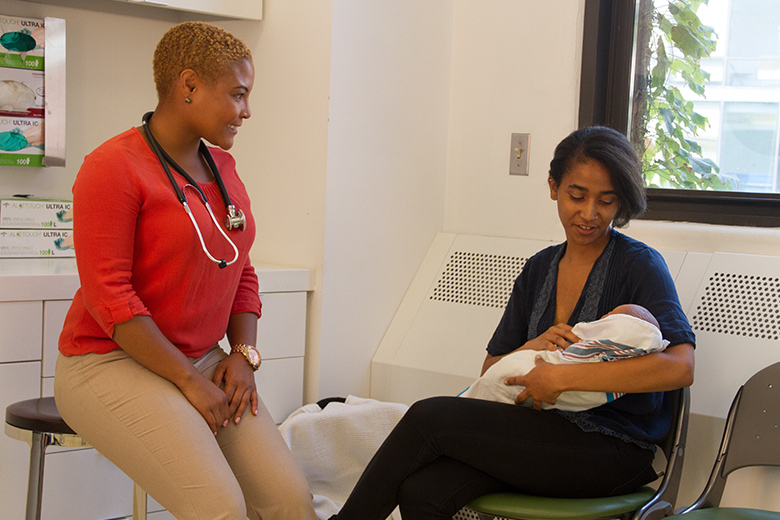

In collaboration with:
The Council on Medical Student Education in Pediatrics (COMSEP)

The 32 interactive virtual patient cases in Aquifer Pediatrics deliver on the learning objectives of the Council on Medical Student Education in Pediatrics (COMSEP) clerkship curriculum.
Overview
Aquifer Pediatrics helps students develop clinical reasoning skills critical to becoming a successful practitioner. Our virtual cases provide key content correlated to COMSEP's learning objectives—a proven path to success in developing clinical reasoning skills.
Key Features
- Created for educators, by educators, to cover the full range of COMSEP's curriculum
- Available for institutional subscription or for direct purchase by individual subscribers
- Validated 100-question online summative exam available at no additional cost through the 2022-23 subscription year
- Proven pedagogy that standardizes experiences—overcoming geography, seasonality, and accessibility
- Evidence-based, peer-reviewed, and continuously updated content
- Self-assessment questions emphasize key content and enable students to test their knowledge and skills
- A wealth of source material, tools, and full references in each case
- Course-specific student and educator resources, including active learning modules (TBL-style application exercises), interactive table of childhood developmental milestones, and a case analysis tool
- Delivered via the Aqueduct learning management system, which includes user management options, easy reporting on student progress and course usage, plus tools for creating custom courses to match a specific curriculum
- Access toAquifer Calibrate: Transformative Assessments for Clinical Learning Mastery, our innovative system for formative assessment, available to Aquifer 2022-23 Curricular Partners
Course Content
With realistic case scenarios that demonstrate best practices, our course builds a bridge from content to practice for our students. Aquifer Pediatrics' interactive virtual patient cases are based on the COMSEP curriculum, recently revised for renewed and improved attention to clinical reasoning process. The cases ensure that students are exposed to all the various clinical scenarios, irrespective of location or time of year.
Curriculum Integration
Aquifer Pediatrics can be used by third-year medical students, Physician Assistant students, and Nurse Practitioner students as a complement to a clerkship or course on pediatrics. The complementary Aquifer Pediatrics Exam can be used as a summative course exam or as practice for another standardized exam.
Assessment
Aquifer Calibrate, aninnovative system for formative assessments, is in development for Aquifer Pediatrics. The new assessments will combine the concepts of test-enhanced learning and distributed practice tofacilitate efficient study planning and self-directed learning for students, and identify at-risk students and curricular gaps for faculty.
Our current 100-question summative multiple-choice exam will continue to be available through June 2023. Aquifer's online validated summative exam includes 100 multiple-choice questions created by the Council on Medical Student Education in Pediatrics (COMSEP) leaders as an assessment tool based specifically on the pediatrics clerkship curriculum.
The exam is delivered in a secure browser and accompanied by student assessment reports with individual and class data. It can be used to replace or enhance an existing comprehensive assessment or to remediate students.
Case List
Pediatrics 01: Newborn male infant evaluation and care
Pediatrics 02: Infant female well-child visits (2, 6, and 9 months)
Pediatrics 03: 3-year-old male well-child visit
Pediatrics 04: 8-year-old male well-child check
Pediatrics 05: 16-year-old female health maintenance visit
Pediatrics 06: 16-year-old male preparticipation evaluation
Pediatrics 07: 2-hour-old male newborn with respiratory distress
Pediatrics 08: 6-day-old female with jaundice
Pediatrics 09: 2-week-old female with lethargy
Pediatrics 10: 6-month-old female infant with a fever
Pediatrics 11: 4-year-old male with fever and adenopathy
Pediatrics 12: 10-month-old female with a cough
Pediatrics 13: 6-year-old female with chronic cough
Pediatrics 14: 18-month-old female with congestion
Pediatrics 15: Two siblings: 4-year-old male and 8-week-old male with vomiting
Pediatrics 16: 7-year-old female with abdominal pain and vomiting
Pediatrics 17: 4-year-old female refusing to walk
Pediatrics 18: 2-week-old male with poor feeding
Pediatrics 19: 16-month-old male with first seizure
Pediatrics 20: 7-year-old male with a headache
Pediatrics 21: 6-year-old male with bruising
Pediatrics 22: 16-year-old female with abdominal pain
Pediatrics 23: 15-year-old female with lethargy and fever
Pediatrics 24: 2-year-old female with altered mental status
Pediatrics 25: 2-month-old male with apnea
Pediatrics 26: 9-week-old male not gaining weight
Pediatrics 27: 8-year-old female with abdominal pain
Pediatrics 28: 18-month-old male with developmental delay
Pediatrics 29: Male infant with hypotonia
Pediatrics 30: 2-year-old male with sickle cell disease
Pediatrics 31: 5-year-old female with puffy eyes
Pediatrics 32: A Day in Pediatric Dermatology Clinic
From Our Cases
Educator Resources
In addition to the 32 cases included with this course, the Aquifer Educators Consortium has developed Educator Resources to accompany this course, available to all subscribers. Resources include valuable teaching and learning tools to increase student engagement and maximize efficiency for faculty.
To access these tools, sign in to your Aquifer account and visit the Educator Resources section.

New Educator Guide Available
Course Overview – Integration Strategies – Educator Resources – Learning Objectives
The Educator Guide—available to all subscribers—provides a quick reference guide for all cases, resources, and features included with Aquifer Pediatrics. The Educator Guide is ideal for educators who are getting started using Aquifer, or experienced users who want to be sure they are taking advantage of Aquifer's extensive resources and tools. Learn more…
User Story Video
Learn how Aquifer Pediatrics can benefit medical students and faculty in your program:
Aquifer Pediatrics Course Board
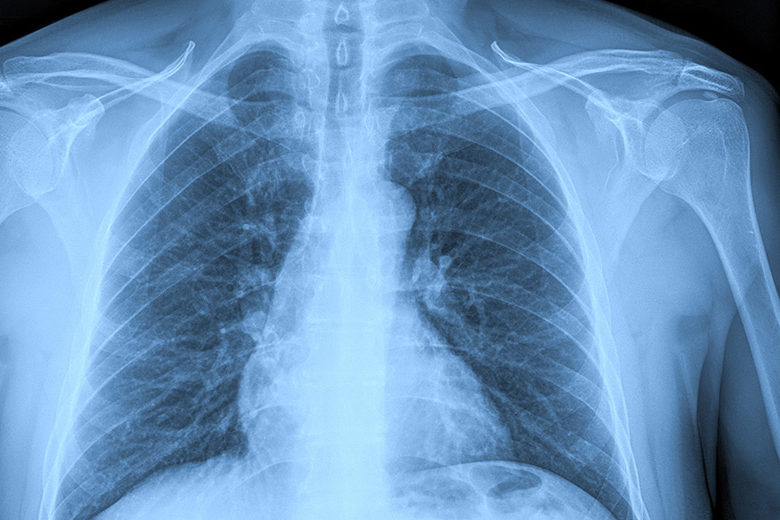

In collaboration with:
Association of University Radiologists & Alliance of Medical Student Educators in Radiology

The 21 interactive virtual patient cases in Aquifer Radiology deliver on the learning objectives of the Association of University Radiologists (AUR) and the Alliance of Medical Student Educators in Radiology (AMSER) medical student curriculum.
Overview
Aquifer Radiology's virtual patient cases are realistic case scenarios that demonstrate best-practices—helping students develop clinical reasoning skills that bridge the gap from content to practice. In an era of the increasing importance of evidence-based decision making and reliance on imaging, an understanding of the principles and applications of radiology is vital for today's healthcare professionals. The National Board of Medical Examiners has recognized this by increasing the imaging component of all United States Medical Licensing Examination exams.

New Cases Now Available
Aquifer Radiology 20: Interventional Radiology – Vascular
Aquifer Radiology 21: Interventional Radiology – Nonvascular
The new cases, which cover the role of IR and the basics of common problems, are designed to build a foundational understanding of how to use IR as a consultation service, providing valuable knowledge for learners advancing to any specialty. The new cases are now available to all Aquifer Radiology subscribers. Learn more…
Course Details
Key Features
- Created for educators, by educators, utilizing the American College of Radiology (ACR) Appropriateness criteria
- Available for institutional subscription or for direct purchase by individual subscribers
- Validated 100-question online summative exam available at no additional cost through the 2022-23 subscription year
- Proven pedagogy that standardizes experiences—overcoming geography, seasonality, and accessibility
- Evidence-based, peer-reviewed, and continuously updated content
- Self-assessment questions emphasize key content and enable students to test their knowledge and skills
- A wealth of source material, tools, and full references in each case
- Educator resources, including complete flipped classroom PowerPoint workshops for each case—with speaker notes
- Delivered via the Aqueduct teaching and learning platform, which includes user management options, easy reporting on student progress and course usage, plus tools for creating custom courses to match a specific curriculum
- Access toAquifer Calibrate: Transformative Assessments for Clinical Learning Mastery, our innovative system for formative assessment, available to Aquifer 2022-23 Curricular Partners
Course Content
Aquifer Radiology cases teach a patient-centered approach to imaging, foster self-directed and independent study, and build clinical problem-solving skills. The realistic case scenarios teach evidence-based decision making and include excellent interactive radiology resources.
Curriculum Integration
These cases can be used as a stand-alone radiology course during a radiology clerkship or elective, or be incorporated into the appropriate clinical clerkships as part of a custom course created in Aqueduct. For example, the women's imaging cases can be incorporated into an Ob-Gyn clerkship, or the neuroimaging cases could be used during a Neurology clerkship, thus teaching imaging at an applicable time.
Assessment
Aquifer Calibrate, an innovative system for formative assessments, is in development for Aquifer Radiology. The new assessments will combine the concepts of test-enhanced learning and distributed practice tofacilitate efficient study planning and self-directed learning for students, and identify at-risk students and curricular gaps for faculty.
Our current 100-question summative multiple-choice exam will continue to be available through June 2023. For more information, please read ourFormative Assessment Update.
Aquifer's online, validated, summative exam includes 100 multiple choice questions that include a subset of the AMSER Standardized Exam, created by Association of University Radiologists leaders.
The exam is delivered in a secure browser and accompanied by student assessment reports with individual and class data. It can be used to replace or enhance an existing comprehensive assessment or to remediate students.
Case List
Radiology 01: 23-year-old male: Chest – Infection
Radiology 02: 51-year-old male: Chest – Masses
Radiology 03: 65-year-old male: Chest – Trauma
Radiology 04: 65-year-old female: Chest – Vascular and COPD
Radiology 05: 25-year-old male: GI – Colon and small bowel
Radiology 06: 42-year-old female: GI – Hepatobiliary and pancreas
Radiology 07: 40-year-old female: Renal/GU
Radiology 08: 18-year-old female & 19-year-old male: GI – Trauma
Radiology 09: 34-year-old male: Neuro – Trauma
Radiology 10: 40-year-old male: Neuro – Vascular and HIV
Radiology 11: 8-week old male – Pediatrics A
Radiology 12: 2-month old female – Pediatrics B
Radiology 13: 59-year-old female: MSK – Arthritis, osteomyelitis
Radiology 14: 28-year-old female: Women's imaging – Pregnancy and infertility
Radiology 15: 43-year-old female: Women's imaging – Malignancy and screening
Radiology 16: 24-year-old male: MSK – Trauma
Radiology 17: 65-year-old male: Cardiac and Cardiovascular
Radiology 18: Professionalism in Radiology
Radiology 19: 53-year-old female: Oncology
Radiology 20: Interventional Radiology – Vascular
Radiology 21: Interventional Radiology – Nonvascular
From Our Cases
Flipped Classroom Workshops
Complete Aquifer Radiology Flipped Classroom Workshops are available for 18 cases—ready to use in your classroom. Each workshop, designed to be completed in a 60-90 minute session, includes a powerpoint with images and annotations, speaker notes, and a facilitator guide.
User Stories
Learn how Aquifer Radiology can benefit medical students, residents, and faculty in your program:

On-Demand Webinar
Best Practices for Using Aquifer Radiology Across the Curriculum
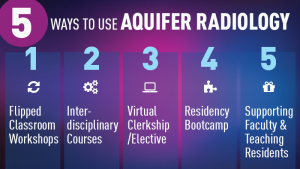
Blog: 5 Ways to Use Aquifer Radiology
Aquifer Radiology Course Board
Source: https://aquifer.org/course-tag/assessment/
0 Response to "Aquifer Family Medicine Continues to Lose Connection"
Enregistrer un commentaire